Welcome. In this collaborative project, 8 people from different walks of life work together to build a public conversation about their individual aspirations for a desirable future.
The Power of 8 project ran from 1st June 2009 to 11th October 2009. It brought together eight people, most of who had never met each other, to imagine ‘optimistic futures’.
The series of blog posts below are a record of their efforts, stories, processes and their designed outcomes which were exhibited at the Watermans Gallery for three weeks, during which 6544 visitors came by. To find out more browse the links above.
We introduce our ideas that formed part of the Power of 8 final exhibition, by taking you on a journey to Acres Green:
“The Eight met at Acres Green by a variety of routes. For some it was an arduous odyssey in which they had to dispense with every uncertainty – yet knew there would be more; for others the journey was spontaneous in the belief that current imperfections would be blown away like a dandelion clock by the power of a new and vibrant reality. Others fell out of the sky via Google Earth. For those of us who actually caught a train, it was a like holding our breath for hours, such was the mounting excitement and frustration as we changed from main line to suburban, then to branch line, getting slower and slower, until finally a relic of the steam age – a tank engine pulling a single carriage – squealed to a halt at an overgrown country siding and let out a long gasp of steam.
A heavy silence hung about us, such as you find in the country on a hot afternoon. Yet there was a smell of damp earth and the bushes gleamed with recent rain. The hard stony soil of the track crackled beneath our feet. Our impression was that this was an interlude between showers.
As we advanced and dwellings became more densely clustered we found that our footsteps were leading us along some predetermined route away from the centre, along more circuitous back lanes. We said nothing; we had seen faces pop up briefly at windows and heads turn in our direction only to turn away again as if we were beneath attention.
Those winding back lanes at least allowed us to get Acres Green into some perspective. It was immediately obvious that it was not a new settlement. There were a couple of rotting post-war tower blocks in the distance and, peering between the trees away to our right, the crumbling façade of a former dog track with its rusted turnstiles. A side wall at the end of a terrace bore in faded outline a list of accoutrements available for Victorian servants.
But the new had gained the upper hand, and it was not the utilitarian, dehumanised newness of where we had come from – new things everywhere suggested a type of consciousness in which developments and innovations were created by and for ‘us’, meaning everyone. They weren’t just technical things either – strange plants abounded, producing different fruits and even growing in different directions. And they were everywhere – in walls, on roofs, even inside the glass pods of the great wheel that arced over the high street.
Unlike the plants, the weather was not everywhere. Sun, rain and mist prevailed at one and the same time in different parts of the village. We were to discover that it was startlingly well controlled. Standing at the edge of a large permaculture plot we were stunned to see a small low black cloud moving among the different crops spraying them according to their needs before spiralling into a seeming nothingness. Then it reappeared directly above our heads. We pulled up our collars and shrank inside.
A playful episode certainly, and apparently meant in a good spirit. But there was tension there, and we weren’t sure how much it had to do with our arrival. Were there different factions representing different philosophies? Or perhaps we had divided opinion about the wisdom of allowing us to visit?”
(What do we find inside Acres Green? How do people live and what do they do? We explain in the posts below, so continue reading…)
Rolling orchards stretched beyond us as we wandered through the edible gardens of Acres Green. Spots of colour peppered the greenery and branches hung low with the weight of ripening produce.
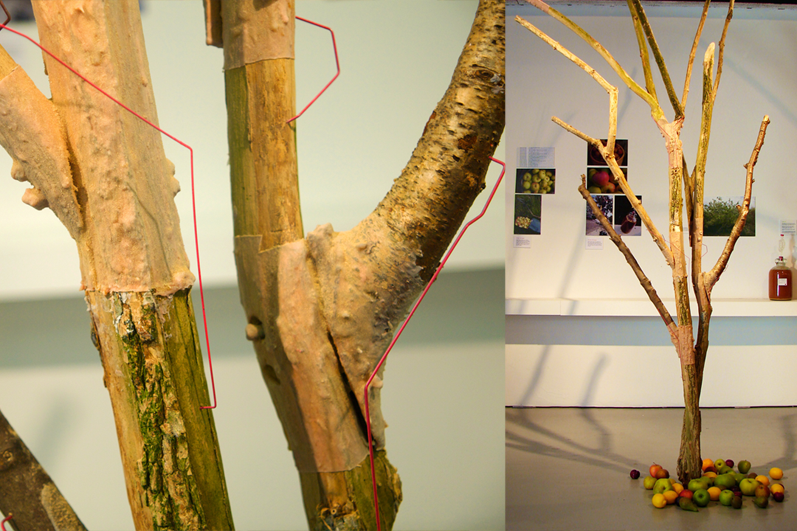
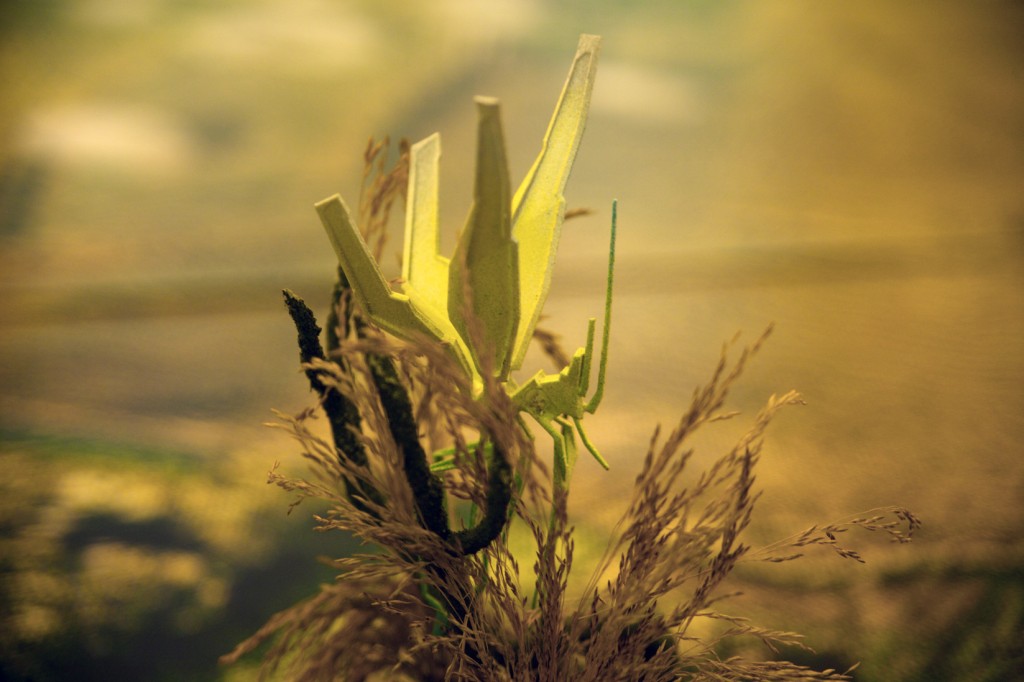
As we looked closer we saw that each tree was actually growing different varieties of fruit. What we originally understood as a tangle of different trunks was actually an intricate technological graft. On parting the leaves we found strange flesh-like prosthesis that seemed to bind limbs from different species together. We realised that to maximise harvests the communities of Acres Green were experimenting with augmented orchards and designing strange new natures.
A prototype showing some of the extreme grafting techniques used in Acres Green to grow different fruits on one tree.
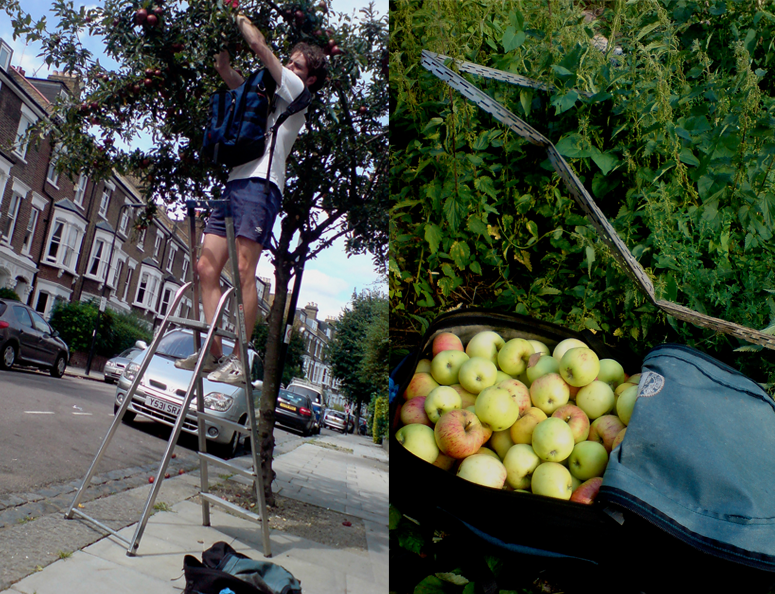
We walked over to pick fruit with a group of locals. It was ‘Harvest Wednesday’ and everyone was out in the orange light gathering their food for the week.
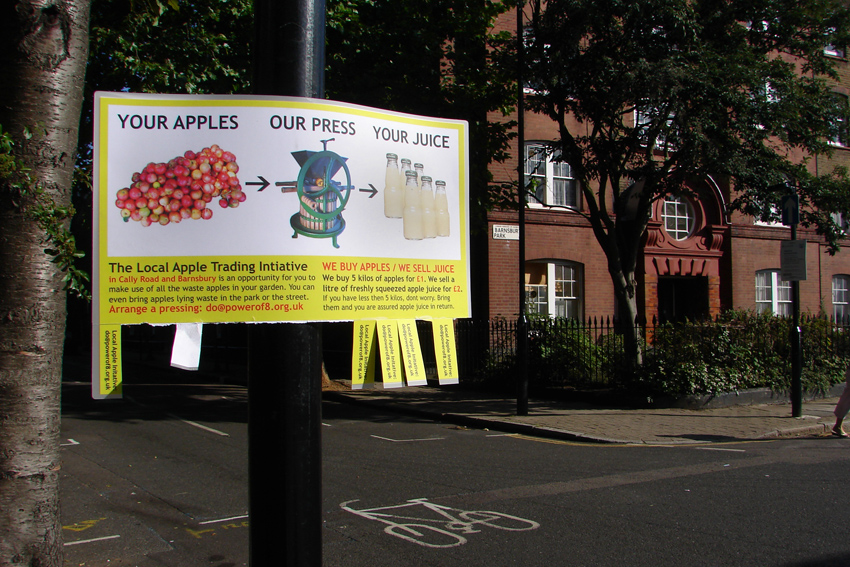
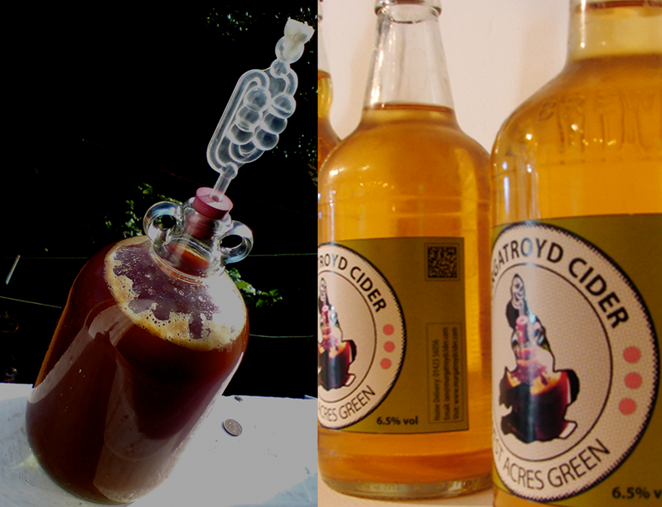
Posters advertising local food-related services found in different neighbourhoods. Locals using feral fruits to make juice and cider.
Under a pregnant tree the apple presses of Murgatroyd Cider creaked and groaned, as they spat cloudy juice into waiting buckets.
The Murgatroyd family started one of the many local businesses around food: A pan-city feral cider business.
Within such extraordinary edible gardens and food orchards, we could not help but wonder what kept this ecosystem so fertile, considering that the so many of our pollinators, including the honey bees, had nearly all disappeared. Then, gazing out across the fields of flowers in the distance we saw tiny glowing creates swarming from plant to plant. We moved on to investigate….
Continuing our journey in Acres Green, from the post above…
The hypnotic dance patterns of small, glowing insects against the warm colours of the dark sky left us in awe, and we wanted to know more. We stopped two people dressed in large netted clothing walking down the street. They introduced themselves as ‘hivers’ and told us the story behind these mysterious creatures:
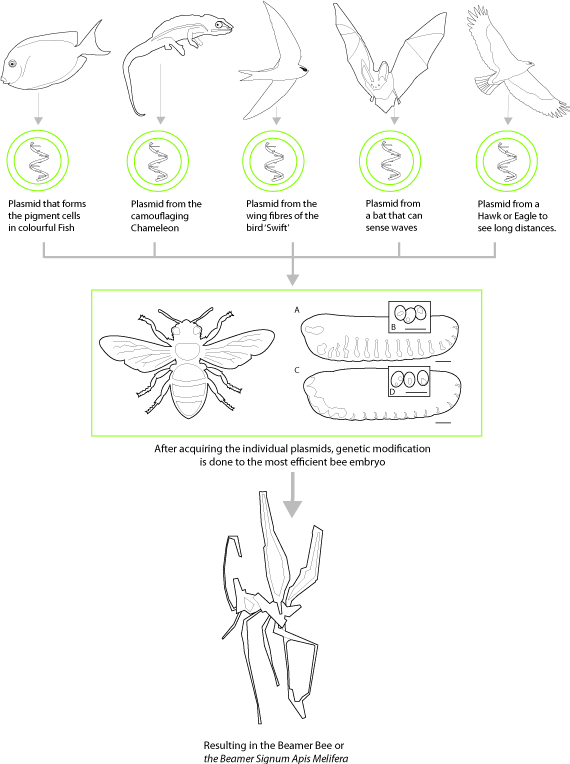
These glowing creatures were the Beamer Bees or Beamer Signum Apis Melifera, formulated by a community of biologists and hired bio-hackers to service under-pollinated trees, plants and vegetables due to the disappearance of honey bees.
Evolution of the Beamer Bees:
The Beamer Bees are guided by radiowaves to crops requiring pollination. They are produced in a limited number each year, and their interactions with the bumble bees and other creatures are tightly monitored. Here’s a video we were shown, about the making of the Beamer Bees and their interactions with our electromagnetic landscape.
It seems that the Acres Green residents can buy licenses to call the bees. License holders use the bugles or other personal mobile devices which transmits radiowaves that the bees can detect. The bees follow the waves to their source.
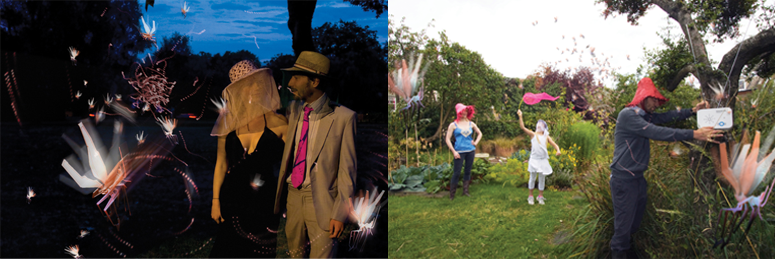
We realised how the Beamer Bees had became central to the Acres Green ecosystem and people seemed to be able to live in harmony with them. The photographs below show us a glimpse of one family’s everyday interactions with the new creatures.
Left: Practical, yet stylish netted fashion ensured comfort on the way to a party.
Right: Gardeners who missed out on licenses opportunistically used wifi routers to attract bees to their plants.
Left: Discovering new cross-pollinated flowers became a new hobby.
Right: The daughter was allowed to keep a glowing bee as a bedside pet.
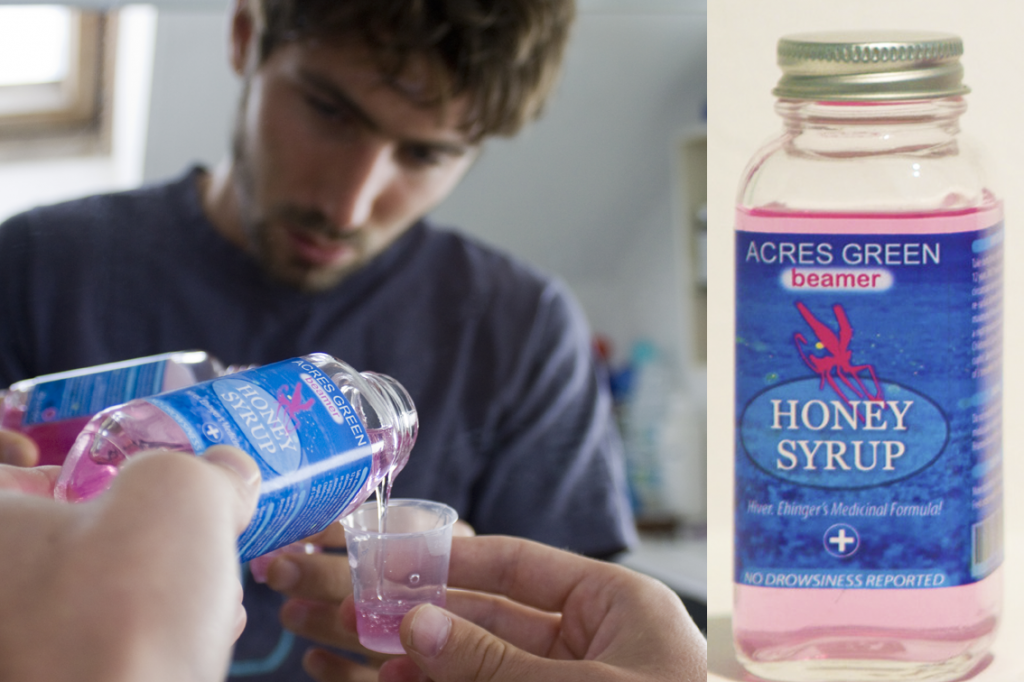
The Beamer honey syrup, with its unique medicinal qualities is prescribed by GPs for allergies.
Within such extraordinary creatures, we wondered what other delights had made their home here. We went further to investigate…
[*Beamer Bees Project Update (March 2010): With a focus on this new kind of 'communication' between humans and animals/insects, we are developing the Beamer Bees project furtheranddesigning more elaborate, poetic visualisations of the interactions between people and these new creatures. We are also looking into the best possible way of illustrating the beautiful swarm-like patterns of the bees' movements, and how they might be controlled by our device.
Regarding the Colony Collapse Disorder, Anab meet bee health expert Dr. Dave Chandler last week, who will be advising us further.]
[Background context for the design of the Beamer Bees: The mysterious disappearance of bees have remained a source of concern for a long time now. Experts have tried to pin down several reasons which include exposure to genetically modified crops, pesticide poisoning, invasive parasites, malnutrition from pollinating vast tracts of crops with little nourishment, and the stress of being moved long distances. Some even suggest that the growing electromagnetic radiation could be a reason that should not be overlooked, as they radiowaves ‘confuse’ the bees’ radar and they don’t return back to their hives. Besides the honey bees, many other pollinating creatures including the native bees, butterflies, other insects, bats, and hummingbirds are in grave danger too.
During our discussions, it became apparent that we were interested to find ways of saving the bees, but our responses could be varied - from direct impact to more critical. This particular idea for the creation of Beamer Bees is critical, and a technique to further the debate, imagine new possibilities around emerging technologies, and also visualise sensual, emotional interactions.]
A visit to the high street was no less intriguing for us. More amused were we by the immense object standing before us than the otherwise normal offerings of paracetemol and coloured pantyhose. Occupying the full width of the road and towering some three - maybe four - storeys above our heads was what seemed like a floral-clad mountain. Tall, yes. Massive in its proportions, certainly. But it invited us in with a gaping cave-like entrance at its base.
The mountain serves as a cool oasis in an urban heat island in summer, becoming a temporary vertical marketplace.
As we moved closer we realized that it seemed to be ingeniously constructed of long plank-like blocks that appeared semi-translucent where its raw surface was exposed under the foliage. It was warm to the touch even in the cool of that autumn evening. Peering closer to the blocks, we could see a faint yellowish glow from within.
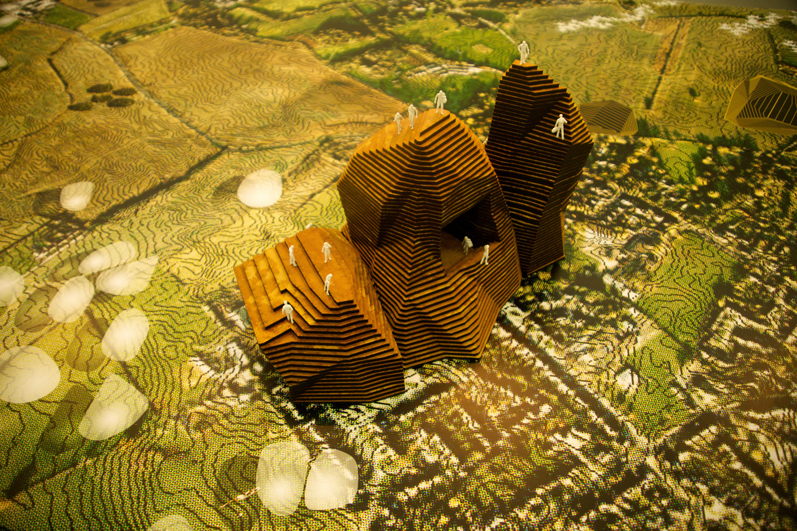
A local person later explained that the mountain was made from transparent blocks, which were filled with a wax-like material harvested from the beamer bees! The wax enabled a more efficient means of storing heat by capturing temperature change when the wax turns to liquid. The blocks were easy enough to assemble and fill by locals and as a result every springtime, the Acres Green residents gather to build the edifice several terraces higher than the year before.
Aerial view of the living mountains in Acres Green
It seemed this mountain had a life for every season - a plant-growing structure in summer, a school for adults in autumn, a venue for clandestine meetings in winter, and a community building project in spring. The mountain got wheeled around Acres Green to suit the different needs of the community - the mountain in transit being somewhat of a spectacle in itself.
And other mountains of slightly different specification were deployed all over Acres Green for moss-harvesting, bird-watching, saunas, therapy rooms, and meeting points for creative exchanges.
In autumn its warm interiors host the new school term, and it becomes a space for exchange of ideas without hierarchy.
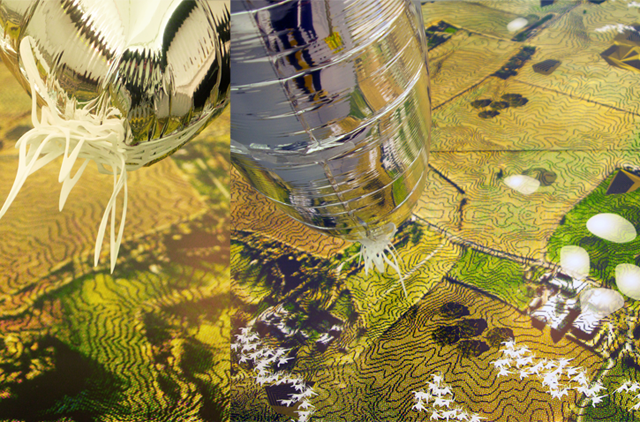
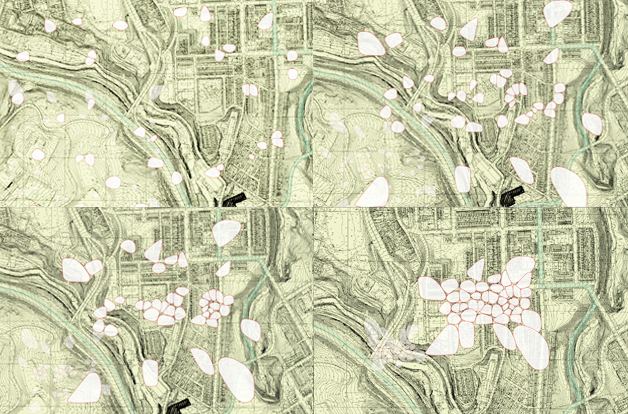
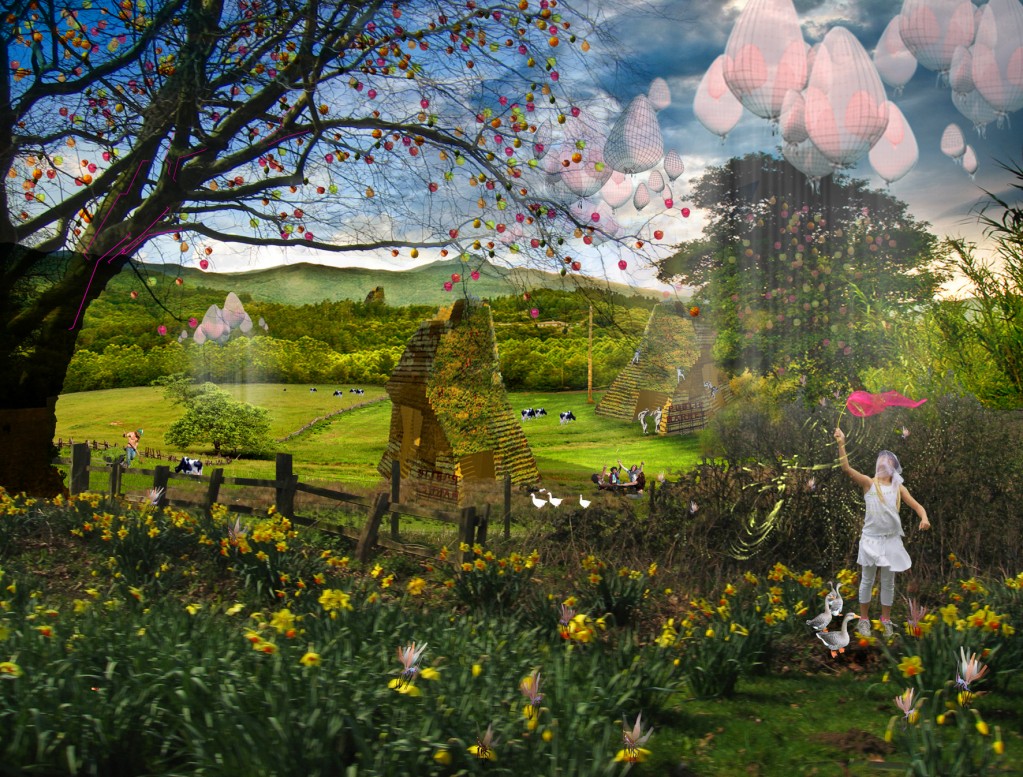
As we snuggled comfortably in the warm interiors of the mountain, we heard shouts of glee from the children who were playing outside, and our curiosity got the better of us. We stepped out to see that the skies above Acres Green are dotted with small cloud-like floating bodies that were gently flocking close to each other in beautiful patterns. We were told that these flocking clouds were controlled by embedded robotics and would fly freely in the space, but on closer encounters, tessellate to bring rain to drying areas.
The large surface area of each cloud was used to condense water particles, just like fog catchers, and then the particles would run down and be stored in the clouds’ undercarriage. When they came together in tessellations this water would be released to form rain. While the locals enjoyed watching the clouds, and were happy to sustain their desired ecoystem, many unintended consequences of these new machines had also begun to surface…
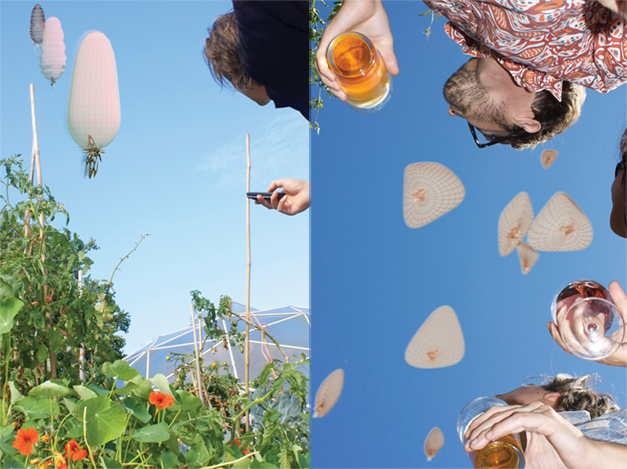
Left: While planters and gardeners were able to order clouds over a dry patch, Right: Some others also ordered them to cool off at a garden party.
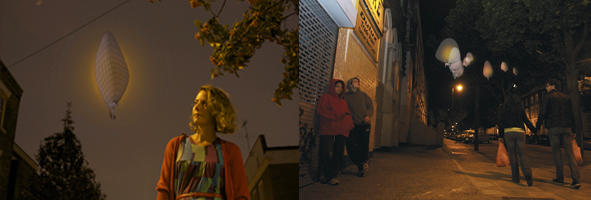
Left: A single glowing cloud often provided company on a late night walk home. Right: But bored kids hacked the network and managed to turn the rain filled clouds onto passers by.
This is the last post on the final outcomes of the project. Posts below take you through our process and how we got here.
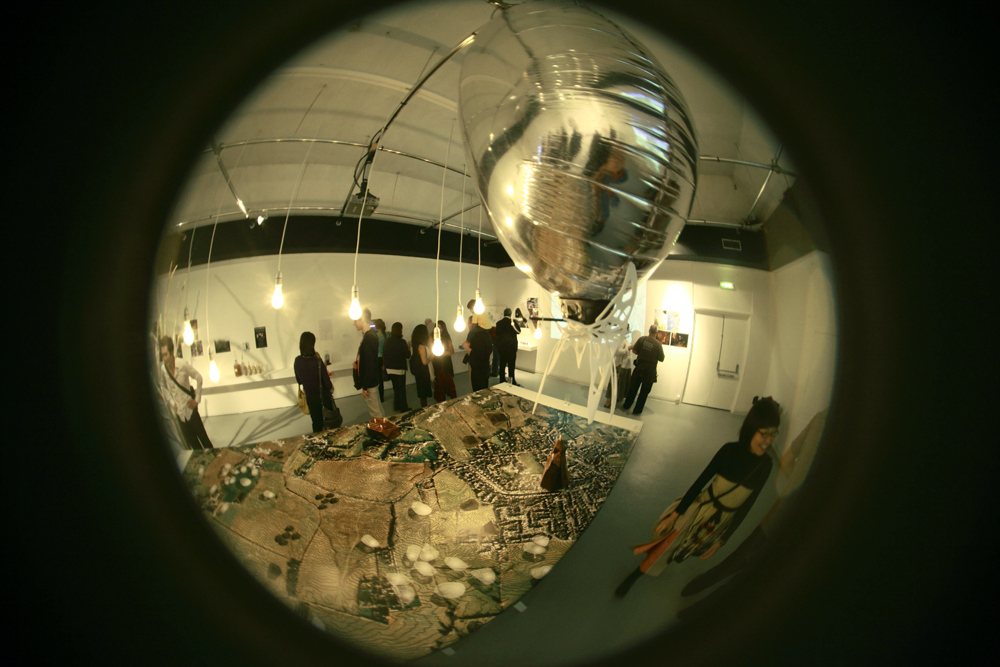
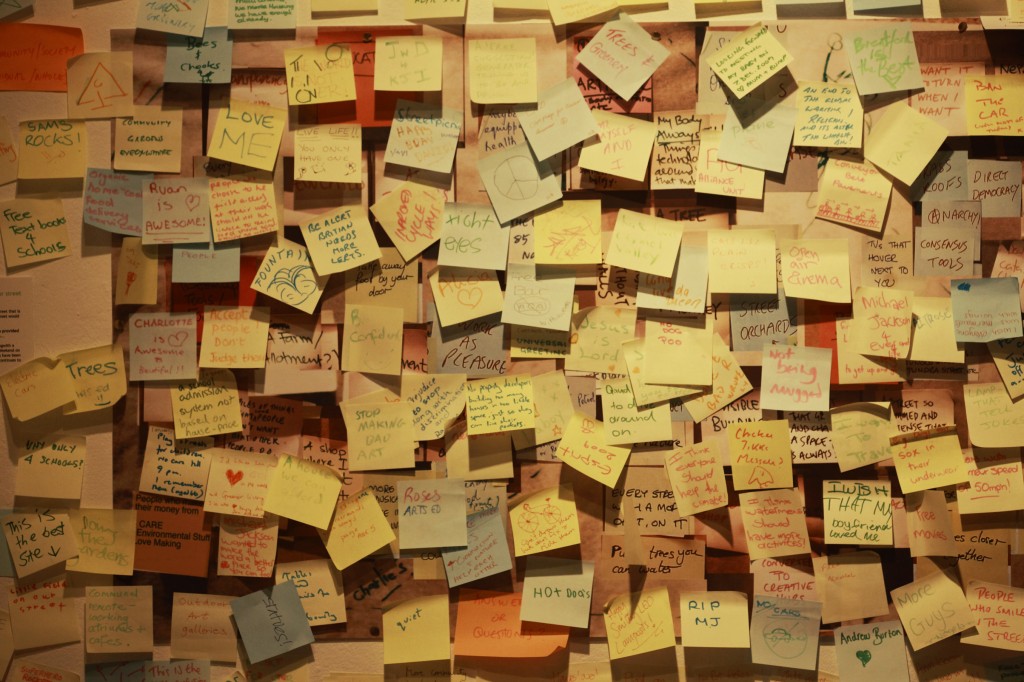
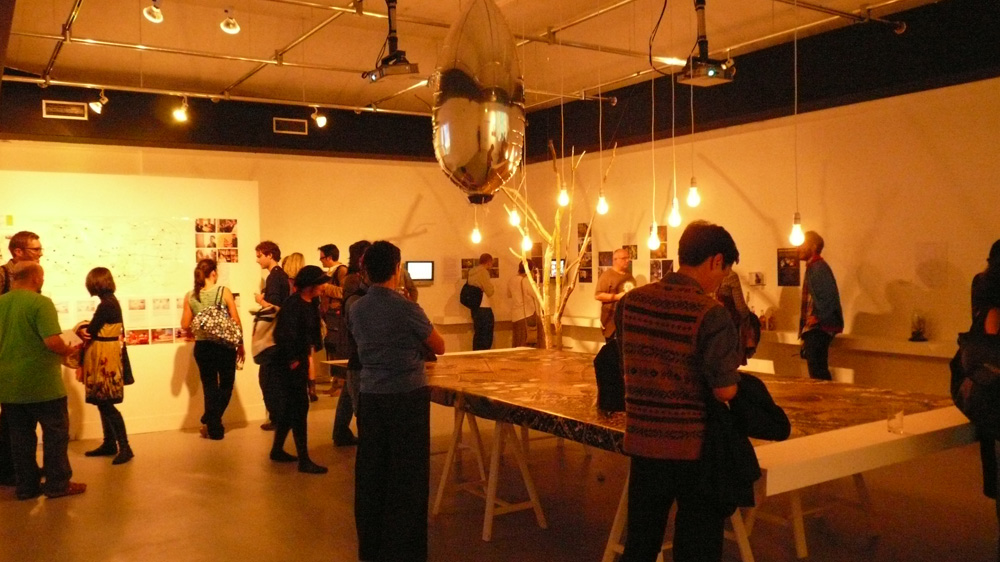
The Power of 8 exhibition went up on 22nd September, was open to the public for three weeks and finally came down earlier this week. Here are some pictures that will give you an idea of how it looked in the space. For us, well, we think it has been a huge collective success to pull off the entire project with a big show in less then three months. We are all proud and yes, very tired. Which is why there has been a bit of silence on this front, as we try and get our lives back.
Looking back at when it all began less then four months ago, it is hard to believe so many of us had never met each other. While its not been an easy process to get us to come in the same room together, forget working together, we tried. We created collages, wrote stories, drank tea and made experiments. We also created maps and paths of the futures we would like to live in.
After many, many conversations and idea exchanges, we realised that while it has been our ambition to tell an optimistic story about the future, we wanted this story to bring forth the inherent dilemmas and complexities of any such endeavor. So we have tried to imagine a world where humans attempt to adopt and invent new technologies and patterns of behaviour that bring them closer together, while also striving to show what the consequences of such attempts might be.
Over the next few posts, we would like to introduce you to our ideas and show how this project has been an opportunity for us, as a collective group, to give form to some of our aspirations as well as concerns about the future.
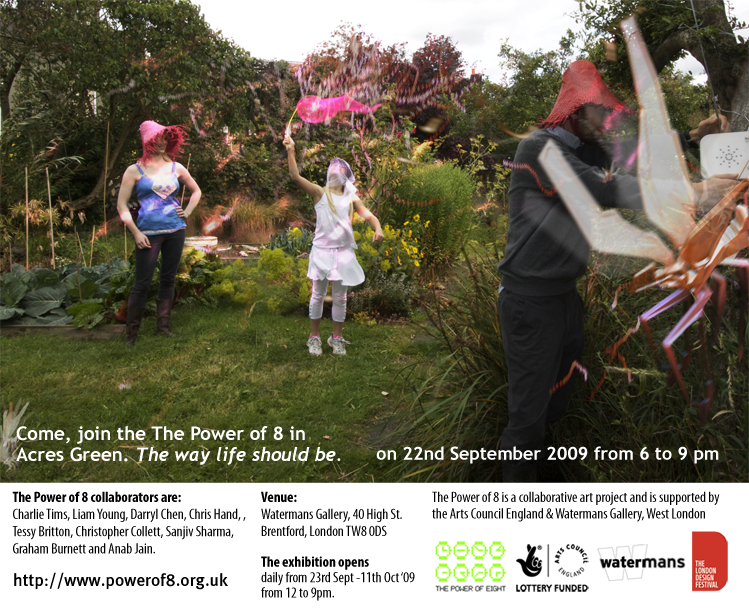
We are excited to invite you to the private view and opening of our exhibition on 22nd September 2009 from 6 to 9 pm at Watermans Gallery, as part of the London Design Festival.
What do you want from the future. A house? A car? A family? Some grandchildren? Maybe you want a better job or to see a bit more of the world. It isn’t that hard to think about what you want, but will you get it?
What kind of a world will your dreams meet? Global warming, a rapidly aging population, mass migration and transformations in science and communications cloak our futures in uncertainty.
A less predictable world leaves fewer people who can offer us conviction and confidence in the future - we don’t trust politicians, corporations are only in it for their shareholders and the world’s religions are fragmenting into different creeds and belief systems. Even if there was some all powerful, popular, trust worthy leader to haul us through, unpredictable events like 9/11 and the credit crunch would always end up wrong footing them.
The only thing we can know about the future is that it will be made by many people. People who have been educated differently, who have completely different outlooks and aspirations who speak different languages, wear different clothes and like different food.
That’s where the Power of 8 came from. Bringing together an educator, a permaculturist, a technologist, a policy researcher, an urbanist, a retired civil servant, a scientist and an interaction designer the project has bought together people with radically different perspectives to imagine how we could live in the future.
Some of us see the future through technologies that will help us self-medicate, replicate and create. Some of us look at the future stymied by the weight of a thousand books that remind us that man is always his own undoing. Some of us would rather stare at saints, heroines, innovators and wish that one day we will all be like that. Some of us just close our eyes and dream, hoping that if we keep putting one foot in front of the other we will get there eventually.
The future is a date, but it’s also a story about our lives today. It’s out there if you look for it. It’s there at the back of the garden. It’s there for two minutes at five minutes past seven during a repeat of Dads Army on BBC4. It’s on page thirty seven of a discarded Sunday colour supplement that’s wedged into the back of your tube seat. It’s what echoed in the underpass after the pubs threw everyone out last night. It’s etched into the back of two pence piece in a winter coat you haven’t worn since March.
We’re all looking for chipped shards of futures in our own ways, in our own places. The Power of 8 has gathered a few that we found to create one mosaic into which our hopes squeeze. The project has produced a vision of a future, but the way it came about is a reflection of how future will come. Our hope is that somehow through the chaos of different ideas, inventions and organisations a more loving, just and humane future can prevail.
We are not posting as regularly as we’d like to, simply because things are getting unusually hectic as we have a rather ambitious plan for the show (opening 22nd September), and for the London Design Festival. All I can say is that we are attempting to create ‘A Proposal for an Alternate, Augmented Ecosystem‘, worded nicely by Chris Hand, our newest team member.
Meanwhile here are some extracts from our email exchanges (in no particular order), just to give you a flavour of where we are at:
From Charlie on 18th August:“…Anab and I have been door to door trying to find apple trees but it was a somewhat, er, fruitless endeavour (if one in 10 houses has an apple tree and 3 in 10 people are at home at 11am on a Saturday morning in mid august that means if you knock on a door you have a 3% chance of finding a tree). But we now have a couple of posters. how cool are they? ‘Report a tree - Win a Giant Pie’ - that is a message people need.”
From Darryl on 14th August: “The hills are alive….Scene 1 Summer: Mountain is wheeled through the streets of the city. A sleeping giant. It compliantly takes its place among towers on the burning bitumen of the urban heat island that is our contemporary cityscape…”
From Chris Hand on 19th August: “Got a proper radio controlled thing in the post today, and went to get it filled with helium (I’m getting to know the lady in the party supplies shop quite well now…) Good news is that it’s WAYYYY more buoyant than any of the other balloons I tried…”
From Liam Young on 11th August: “… this narrative device could be interesting for us. We could take about our community and their suburb with the language of a description of a picturesque garden, a landscape painting or the romantic poets…”
From Tessy on 11th August: For me probably the biggest *concept* around here is a substantial blurring of boundaries - between home/work, private/public, owned/shared, passive/active…. How could we present these complete shifts in thinking and behaving. I can almost see us living in a much more fluid state…”
From Sanjiv Sharma on 20th August: “Lets start from the beginning… To look attractive with all that fluorescent colour and colourful we will need it to have a part of the DNA sequence called the plasmid that form the pigment cells in colourful fish…”
From Chris Collett on 25th August: “I think the proper theme for an introductory text, is not the inner substance of our future community, but the ecological/social/philosophical problems of the economy and society from which we are trying to escape, and how it propels us, individually and collectively, towards this better future; indeed, how every human being must be so propelled sooner or later…”
Anab Jain on 11th August: “…about the ‘time frame’ for this future, to say how we have sort of purposefully decided not to situate our future in a particular year - say 2022. And why. I think we decided not to do so because the word ‘future’ will always remain relatively abstract - while here we focused a lot more on what we want, and how we want to go about it, rather then ‘when’ we want it.”
Graham Burnett on 29th July: “Using real branches will be challenging as the leaves will droop very soon after the branch being cut from the tree, within hours if not sooner… I have a family apple tree in my forest garden, and would like to graft more in the spring, maybe we could do that as a ‘Power of 8′ related spring project???
Here’s the map of our post-psychogeographies, which was also exhibited as part of the Open Weekend. It is a map showing where our ideas traveled and paths coincided. All these ideas have resulted in a rather exciting collective vision, with sufficient doses of lyrical realism and enchanting ambiguity. We are now in the process of making them tangible for the final show, and will keep updating our sketches as and when possible. (click to see larger view)
Marketing has evolved beyond simple advertising—it is now about creating authentic connections between brands and customers.
In a world where every impression matters, businesses must use strategy, data, and creativity to reach their ideal audience effectively.
That is where partnering with a professional facebook marketing agency can make all the difference.
With the right team, you can turn your campaigns into powerful stories that drive awareness, generate leads, and build long-term loyalty.
A strong marketing strategy starts with understanding people—their habits, needs, and motivations.
Agencies use research and analytics to identify what resonates with your audience and how to deliver that message across the right channels.
Whether it’s social media, paid ads, or content marketing, the focus is on building trust while inspiring action.
This blend of creativity and precision helps brands stand out in a crowded marketplace and capture the attention of those who matter most.
True marketing success also comes from testing and adapting.
Instead of relying on guesswork, agencies analyze performance data to refine campaigns in real time, ensuring every dollar spent produces measurable impact.
They identify which messages convert best, which audiences engage the most, and how to scale campaigns without losing efficiency.
This approach turns marketing into an ongoing process of discovery and growth rather than a one-time experiment.
At its core, great marketing is about balance—using creativity to inspire and analytics to guide.
With the expertise of a skilled team behind you, your brand can navigate the fast-changing digital landscape with confidence.
Partnering with experts helps you focus on what you do best while they handle the strategies that drive measurable growth and deeper audience relationships.


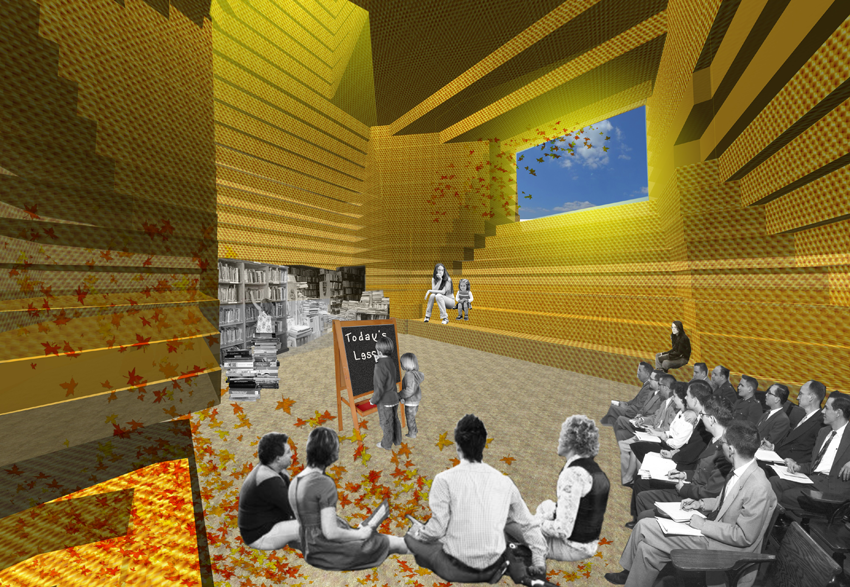 In autumn its warm interiors host the new school term, and it becomes a space for exchange of ideas without hierarchy.